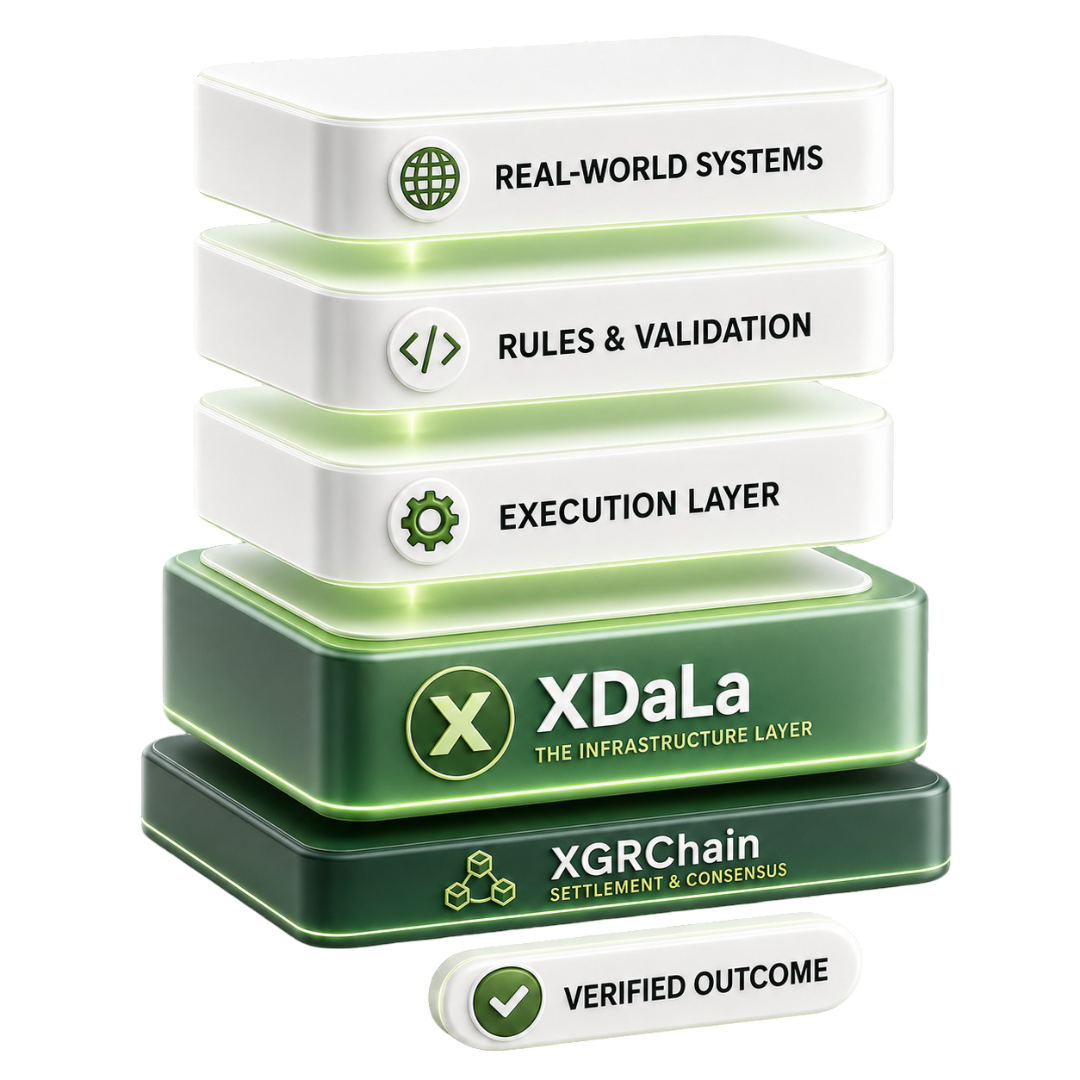
XGR.Network has published an updated public architecture for AI-assisted execution and payment workflows. The architecture separates agent reasoning, deterministic policy and process control, signing authority, and on-chain settlement instead of treating them as one opaque autonomous component.
The model is designed for cases in which an AI agent may inspect information, prepare an action or initiate a workflow, while the conditions for execution remain explicit and verifiable.
A five-layer execution path
The public architecture is presented as a five-layer path:
- AI agent: discovers information, reasons over available evidence and prepares an intended action.
- XGR MCP Gateway: exposes semantic tools for live chain evidence, XDaLa workflow discovery, artifact validation and controlled operation handoffs.
- XDaLa: applies deterministic rules, external-data conditions, authority checks, approvals and multi-step orchestration.
- Wallet or custody: retains the final authorization and signing boundary.
- XGRChain: executes and settles the authorized transaction while preserving persistent evidence.
This separation is central to the XGR security model. The MCP Gateway does not request or store user private keys and does not sign transactions on behalf of users. A wallet, custody setup or separately authorized wallet agent remains responsible for the final payment or transaction signature.
Controlled payment preparation
Where the optional mainnet purchase tools are enabled, an MCP-compatible agent can prepare a bounded XGR purchase order. The XGR backend remains authoritative for the final market price, purchased amount, reservation and exact payment instruction.
The MCP Gateway itself does not hold funds or execute the payment. The returned instruction may be passed to a user-controlled wallet, custody system or external wallet agent operating under its own authorization policy.
This provides a practical agent-payment path without moving user custody into the MCP layer:
intent → policy checks → purchase order → exact payment instruction → external authorization → settlement → evidence
XDaLa as the policy and orchestration layer
XDaLa is responsible for deterministic process behavior. Depending on the workflow, it can validate structured payloads, read external APIs or contract state, enforce limits, coordinate approvals and execute the permitted next step.
This design is intended to support more than token purchases. The same pattern can be used for procurement, compliance-sensitive approvals, trade-finance processes, RWA workflows, API validation and IoT-triggered actions.
Public documentation
The updated public website now places AI-agent execution and controlled payments alongside the existing XDaLa, MCP and XGRChain documentation. Developers can inspect the MCP tool surface, workflow handoff model, XRC standards and public network endpoints before testing the complete execution path.